Photos: Chris Emeott
A Lakeville-based nonprofit raises dogs to help people throughout the community.
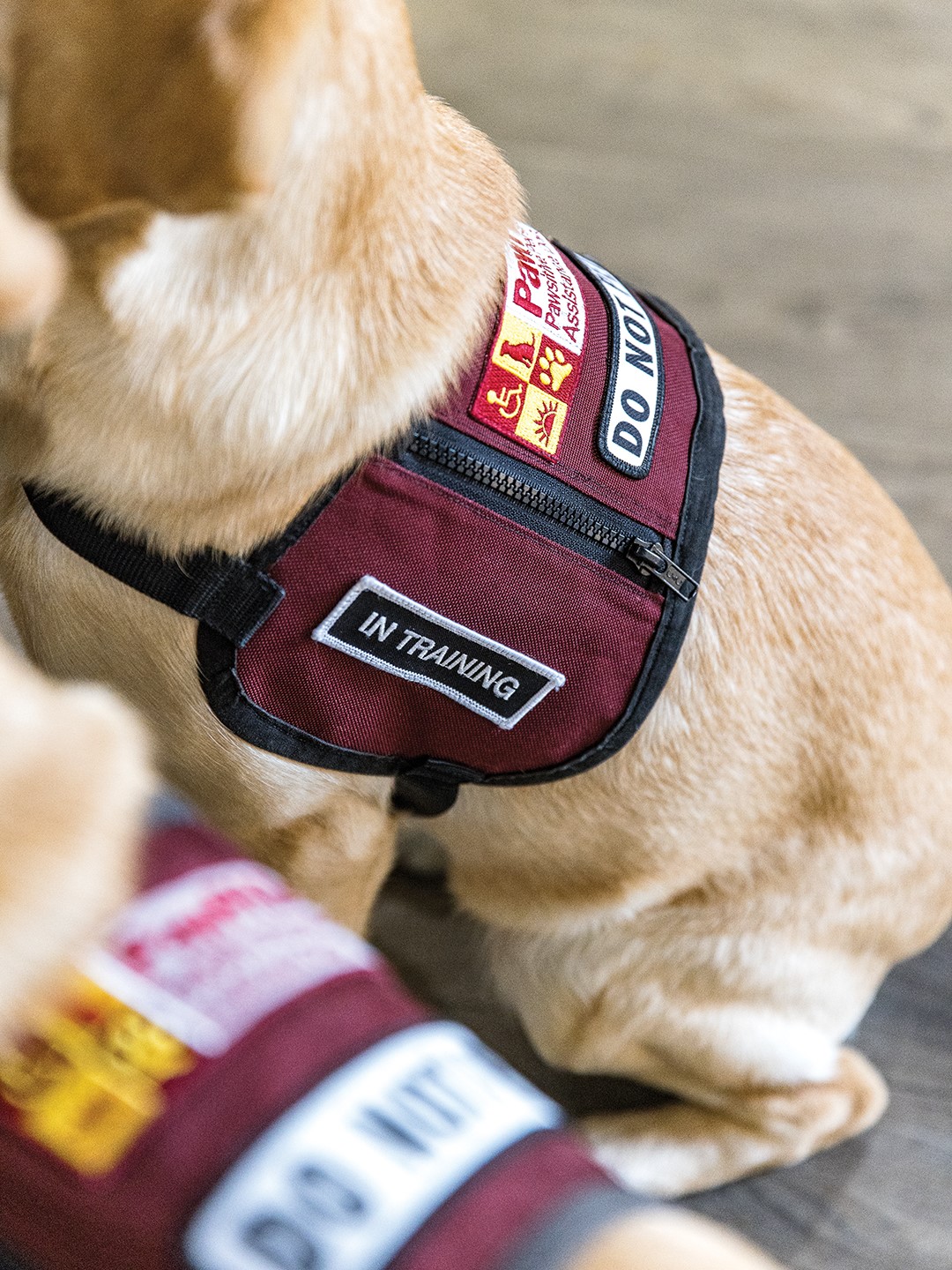
If you’ve met one of the school resource dogs at Lakeville Area Schools, you’ve seen Pawsitive Perspectives Assistance Dogs (PawPADS) in action. The Lakeville-based nonprofit raised Hero, who became Lakeville’s first school resource dog at Eastview Elementary in 2014, and has continued to train dogs for schools and government offices.
But facility dogs for schools are only a small part of PawPADS’ legacy. The group also raises diabetic alert dogs, as well as service dogs who are adept at helping people with physical disabilities.
Linda Ball founded PawPADs in Oregon in 2006 and brought the organization with her when she returned to Minnesota in 2008. As the nonprofit approaches 20 years in operation, it has trained 87 dogs for dozens of clients within 200 miles of the Metro.
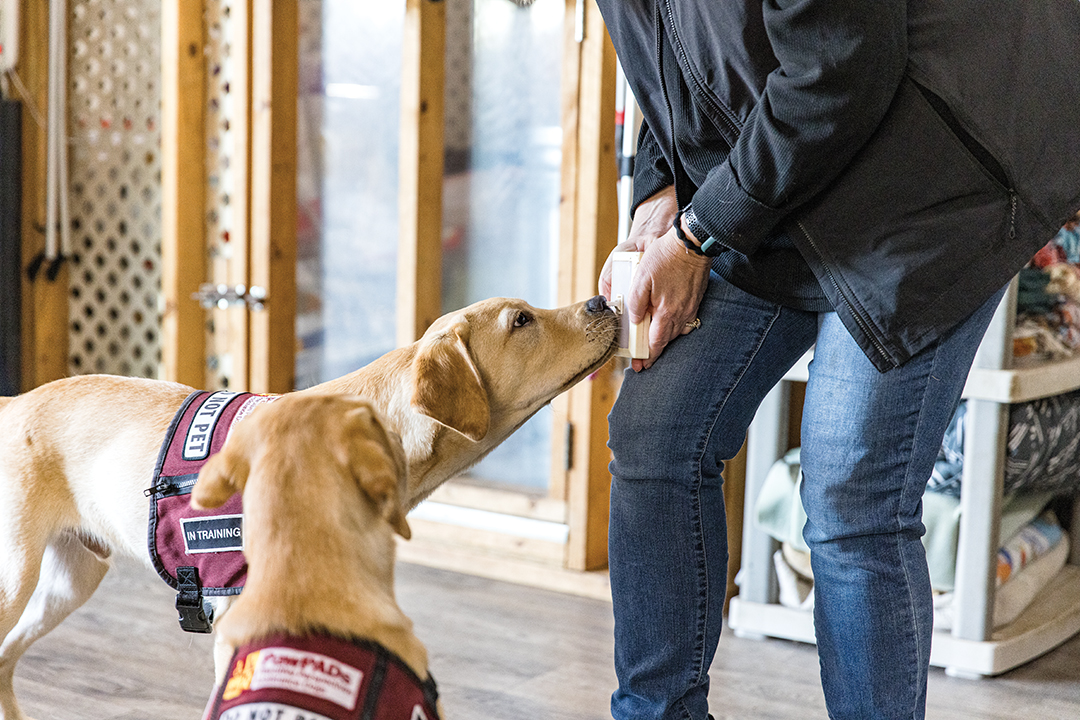
Trainers at Pawsitive Perspectives Assistance Dogs (PawPADS) in Lakeville work with dogs to practice turning light switches off and on.
Training begins when dogs are around 8 to 10 weeks old, and they spend about two years with PawPADs staff or those in training programs. As a group of dogs nears the finish line, Ball and her staff review the waitlist to see if any of the dogs have strengths that will be best suited for clients on the list. “What does this client need? And what dogs do we have that might fulfill that need?” Ball says.
Once they feel confident in potential matches, PawPADs brings a few clients on the waitlist to a 12-day Partner Training Camp, where PawPADs tests if an anticipated match is right for the dog and client before officially partnering them for a crash-course in handling; canine care, health and wellness; and service dog owner rights.
Program manager and trainer Maddie Jensen has observed firsthand how remarkable an intentional partnership match can be. “We have a dog that’s here on training, and all of a sudden they step it up tenfold because they know their partner really, truly needs that retrieve, or they need them to open the door,” Jensen says.
PawPADs has trained dogs by partnering with various entities, like correctional facilities, universities, and youth and veteran programs. The university partnerships, called Assistance Dog Education Program and Training (ADEPT), offer college students hands-on training experience with the dogs in teams of two. ADEPT trained service dogs work with several students over the course of their training. “In their journey, they’re impacting people and changing people’s lives, and then ideally, at the end of that journey with us, they’re placed with their perfect job,” Ball says.
For most dogs, that means joining the 63 percent working placement rate, while others go on to become a beloved family pet.
PawPADs doesn’t use any force or punishment training to obtain these results. “We really want to be fair to the dogs,” Ball says. “We’re asking them to do something in our world, to do something that’s not normal. I think they deserve nothing but the best. It is all reward-based training.”
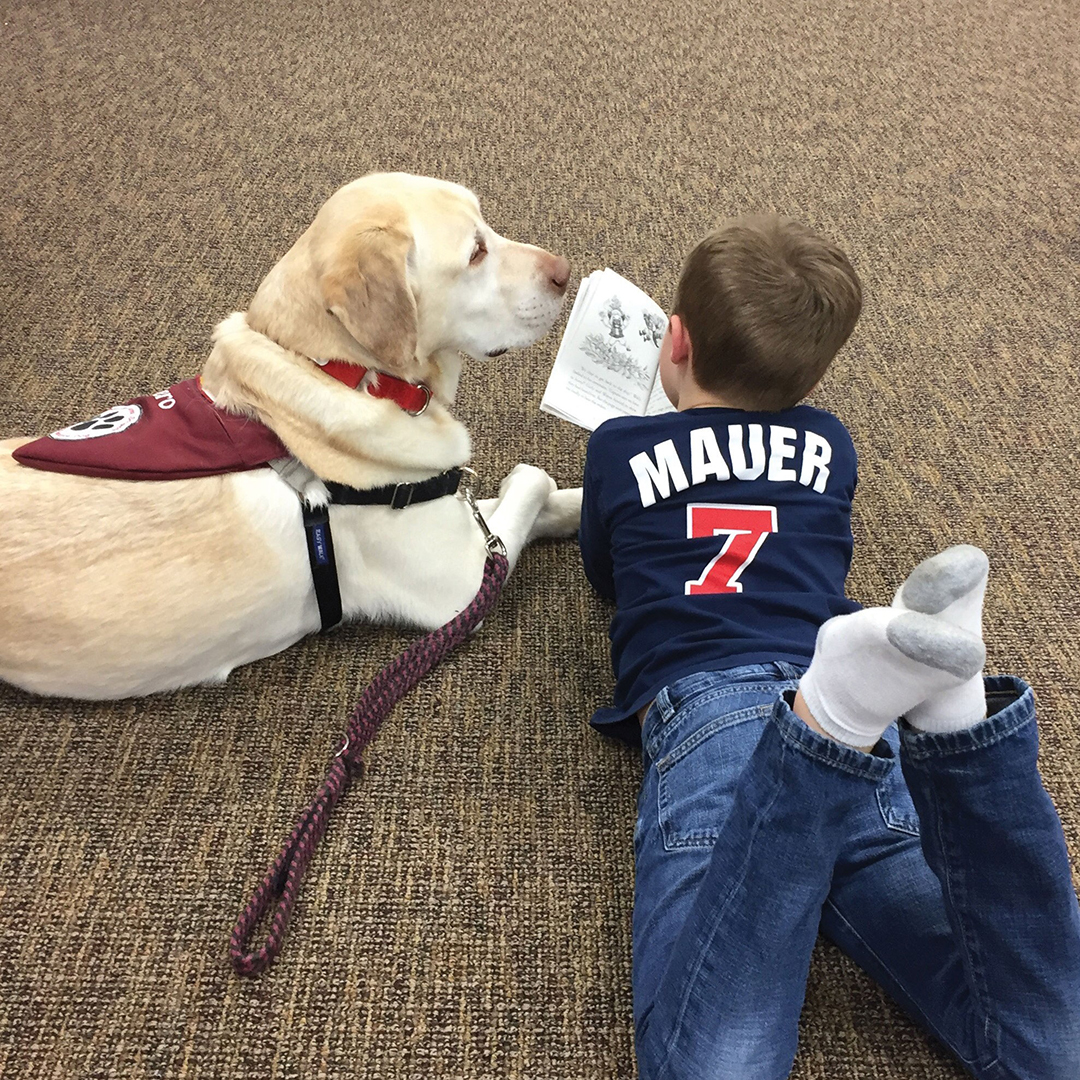
Hero, Eastview Elementary’s first school resource dog, listens as a student reads aloud. Photo: Eastview Elementary staff
Though some dogs don’t have the personality to be a service dog, an alternative path opened through one program at Eastview Elementary. Principal Taber Akin observed the impact that service dogs had on students at other schools, just a few hours at a time, and asked himself: What if the dog never left? To answer this, he worked with PawPADs to bring school resource dog Hero to Eastview.
A school resource dog doesn’t do anything a human staff member can’t do, Taber says, but there’s something about having a dog in a school that offers students a unique level of comfort. “There’s a little bit of magic there,” Taber says. From calming upset children to providing a safe space, dogs like Hero and his successor, Baxter, warm the school’s environment.
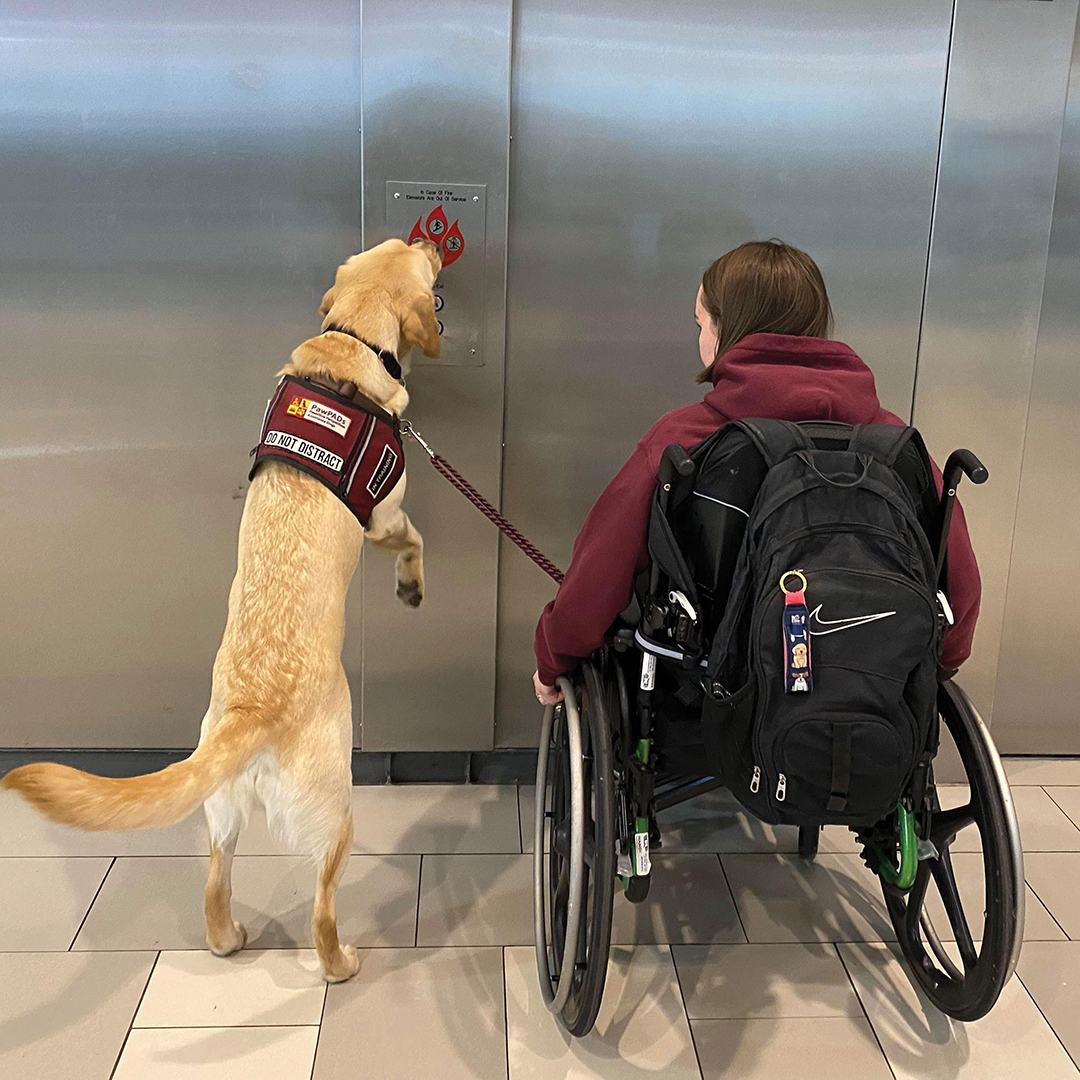
Mackenzie Passel training Charlie at the Mall of America. Charlie has since been placed with Ruby Ardolf. Photo: PawPADS
Though the demand for facility dogs is growing, the majority of PawPADs placements are traditional service or alert dogs. PawPADs recipient Ruby Ardolf, 21, is affected by Strømme syndrome, causing blindness and cognitive delay, and her service dog, Charlie, gives her an independence she wouldn’t otherwise have. “I loved Linda’s philosophy of the right dog for the right person, rather than trying to get dogs placed,” Ardolf’s mother, Angie Diehl, says.
Ardolf was on the waiting list for about two years, and Diehl affirms she would have doubled the wait just for Ardolf to have Charlie in her life.
“Charlie just seemed to be right from the very beginning,” Diehl says.
Keeping PawPADs small, with about 15 dogs in training at any given time, helps with a more thoughtful matching process. The size also keeps staff connected with past clients to offer support even after the matching process, according to Jensen.
One benefit of a small program, Ball says, is the ability to help people in unexpected ways. PawPADs placed Minnesota’s first survivor support dog with 360 Communities and ran a pilot program in Hudson, Wisconsin, to support the sexual assault response team.
The nonprofit hopes to continue serving local communities in unconventional ways, Ball says. “We really believe dogs have the ability to change lives on different levels,” Ball says. “All the way up, as well as through placement.”
PawPADs
Facebook: Pawsitive Perspectives Assistance Dogs (PawPADs)